AI Search Changes Where Customers Research Businesses
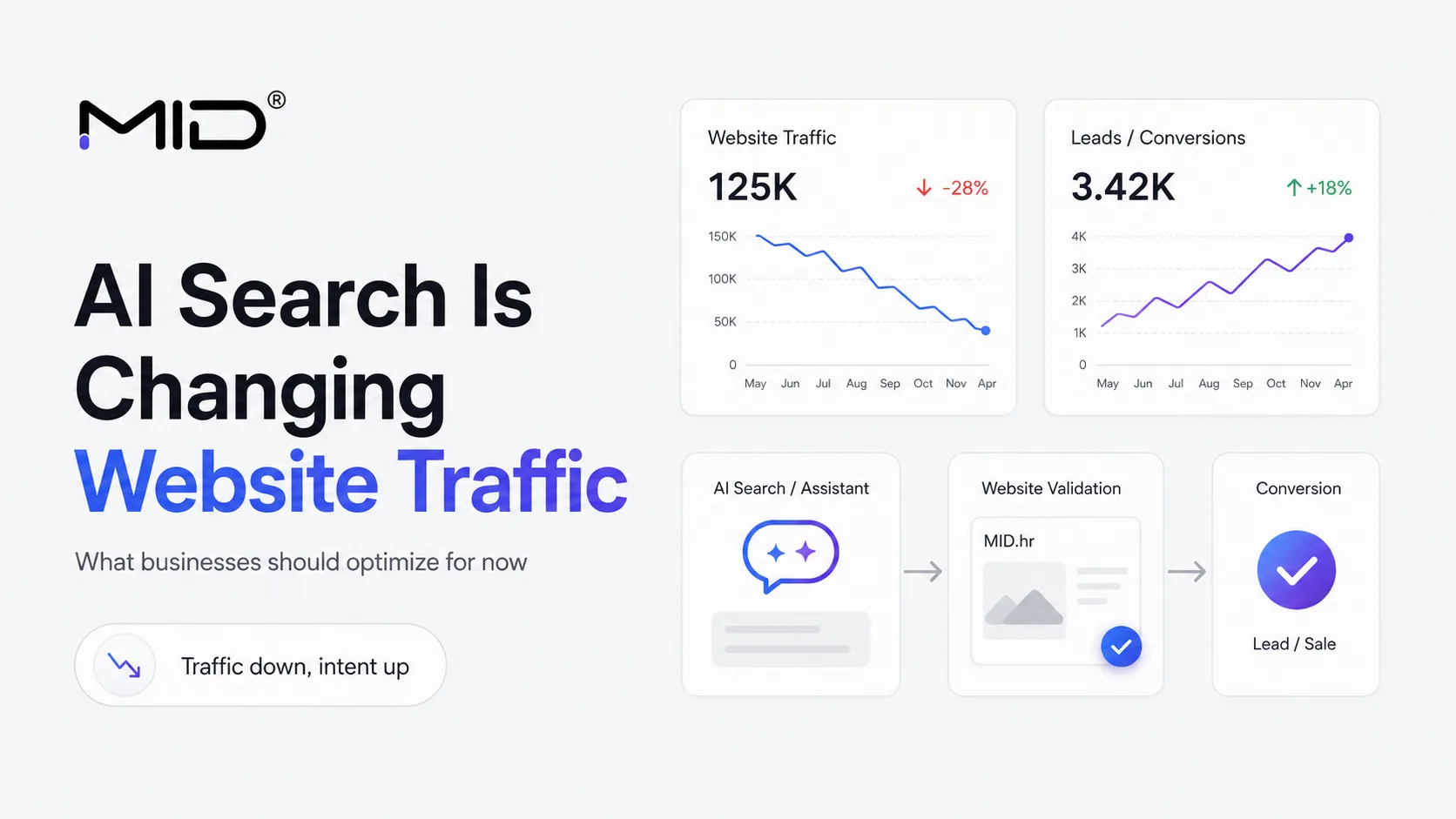
AI search moves part of the customer research process away from company websites. A potential customer can now ask ChatGPT, Gemini, Perplexity or Google to explain a market, compare providers, identify common problems and narrow a shortlist before visiting a single business website.
This change adds to an existing zero-click trend. SparkToro's 2026 analysis of Similarweb clickstream data found that 68.01% of Google searches in the United States ended without a click during the first four months of 2026. The same analysis reported a 60.45% zero-click rate in 2024. A user can therefore receive useful information about a company, product or service without creating a measurable session on that company's website.
B2B buying behavior shows a similar shift. Gartner reported in 2026 that 45% of surveyed B2B buyers had used AI during a recent purchase, while 67% preferred a sales-representative-free buying experience. Another Gartner study found that buyers used an average of seven information sources during a recent B2B purchase. A website remains important, but it increasingly operates as one step inside a wider research process rather than the only place where research happens.
Businesses that want to understand this change should separate discovery from validation. Our guide to using ChatGPT search to attract B2B buyers explains how AI-driven discovery can influence visibility before a potential customer reaches the website.
AI search does not remove the customer journey; it moves more of the research journey away from the website.
Website Traffic Needs Context, Not Panic
Businesses should evaluate website traffic together with commercial outcomes. A decline in sessions can be serious, but traffic alone cannot show whether a company lost interested buyers or only lost informational visits that AI and search engines now answer directly.
Consider a website that receives 10,000 organic sessions and generates 100 qualified leads. Its visitor-to-lead rate is 1%. If traffic later falls to 7,000 sessions while qualified leads remain at 100, the new visitor-to-lead rate is about 1.43%. Traffic fell by 30%, but lead volume did not fall at all. The website now produces more qualified leads for every thousand visits.
The same principle applies to pipeline. If fewer visitors generate the same or greater commercial value, the acquisition channel may be changing rather than collapsing. Businesses should therefore measure sessions, but they should also measure qualified leads, conversion rate, pipeline contribution, branded demand and the behavior of visitors who reach high-intent pages.
SE Ranking's 2026 study provides an early signal worth monitoring. Its dataset showed that AI referral traffic remained small at about 0.32% of total website traffic, but AI-referred visitors spent 67.7% more time on websites on average than organic search visitors. The study reported average session durations of 9 minutes and 19 seconds for AI referrals and 5 minutes and 33 seconds for organic search. Longer sessions do not automatically mean higher revenue, but the difference supports a reasonable hypothesis: some AI visitors arrive after completing part of their research elsewhere.
Measure Intent Instead of Counting Every Visit Equally
- Track qualified leads per 1,000 sessions instead of relying only on total traffic.
- Compare visits to high-intent pages such as services, case studies, pricing and contact pages.
- Connect analytics data with CRM or sales data when possible.
- Monitor branded searches and returning visitors as signals of prior discovery.
- Create a baseline for AI referral traffic and compare its engagement with other sources.
| Kriterij | Traffic-only view | Intent-based view | | ---------------- | ---------------------- | ------------------------------------- | | Primary metric | Sessions | Qualified leads per 1,000 sessions | | Content success | Pageviews | Decision support and conversion | | Search demand | Clicks | Clicks, branded demand and visibility | | Visitor value | Every visit is similar | Visits differ by intent | | Business outcome | Traffic growth | Pipeline and qualified demand |
AI Search Changes What a Business Website Must Do
A modern website must help informed visitors validate a decision quickly. If a visitor has already compared providers through AI, search engines, reviews and industry content, generic statements such as "we provide innovative solutions tailored to your needs" add very little value.
The first screen should tell the visitor what the company does, who it serves and why its offer is relevant. Service pages should explain the actual process, limitations, technology, expected outcomes and next steps. Case studies should show problems, constraints, decisions and results rather than functioning as simple logo galleries. Businesses planning a redesign should treat professional website development as a combination of technical performance, clear information architecture and decision support rather than a visual exercise alone.
Evidence becomes especially important when the visitor arrives later in the buying journey. A potential customer who has already compared three companies needs proof that the shortlisted provider can deliver. Detailed project examples, specific case studies, technical explanations, clear company information and relevant customer reviews reduce uncertainty more effectively than broad marketing claims.
AI search also increases the value of clear, machine-readable information. Businesses should use descriptive page titles, logical headings, accessible HTML content, consistent company information, sensible internal linking and structured data where appropriate. These practices help search engines and AI systems understand a website, but they also make the experience clearer for human visitors.
Content Must Help Buyers Make Decisions
Businesses should create content that adds information AI cannot replace with a generic definition. Basic articles such as "What is SEO?" or "What is CRM?" can still serve a purpose, but AI systems can answer many introductory questions without sending a user to the original website.
Decision-stage content is harder to replace. A detailed comparison between two approaches, a real project breakdown, original benchmark data, pricing logic, an implementation guide or a case study gives the reader information that depends on experience and context. A useful article should answer questions a buyer asks before spending money, not only questions with high search volume.
For example, a web development company can publish content about migration risks, performance trade-offs, custom development versus templates, website redesign costs or how technical decisions affect conversions. MID already covers the wider role of artificial intelligence in business, which connects AI adoption with automation, data and digital systems rather than treating AI as an isolated marketing trend.
The same principle applies to business improvement. A website should not collect traffic for its own sake. It should help the right visitor understand the offer, trust the provider and complete the next meaningful action with as little friction as possible.
Businesses Should Audit the Website for an AI-Informed Visitor
Businesses should review important pages as if the visitor already understands the basics. This simple change in perspective reveals weaknesses that traffic reports often hide.
Start with the homepage and one important service or product page. Check whether a new visitor can understand the offer within seconds. Then review the evidence: case studies, client results, team information, technical details and reviews. Finally, examine the conversion path. A high-intent visitor should not need to search through several vague pages before understanding what happens after making contact.
The audit should also include performance and accessibility. Slow loading, unstable layouts, hidden content and unclear navigation create friction regardless of whether the visitor came from Google, ChatGPT or a direct recommendation. AI search changes the path to the website, but it does not change the basic expectation that the website should be fast, understandable and trustworthy.
Businesses should repeat the audit using different intent levels. An informational visitor may need education, while a buyer returning after comparing competitors may need proof and a clear next step. Treating both visitors identically can waste the intent that AI-assisted research created before the session began.